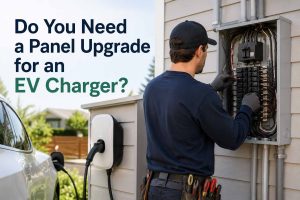
Owning an electric vehicle in Burnaby is no longer something unusual. You see Teslas and other EVs on Kingsway, Canada Way, and around Metrotown all the time. At some point, every EV driver realizes the same thing: charging at home is where the absolute convenience and savings kick in.
If you are starting to explore Home EV Charging Systems, it may be unclear. Amps, levels, kilowatts, panel upgrades, permits… honestly, it is a lot. The good news is that once you understand the basics, everything becomes much less scary and you can make smart decisions that work for your home, your budget, and your daily driving.
This guide walks you through everything, from EV charger levels explained to the real-world cost to operate an EV charger to what happens when a licensed electrician in Burnaby comes to your home. Think of it as the friendly, straight-talking explanation you wish the dealership had given you on delivery day.
Why Home EV Charging Systems Matter For Burnaby Drivers
Let’s be real. Relying only on public chargers is a pain. You have to plan around availability, hope no one is parked in the EV spot without charging, and cross your fingers that the charger isn’t out of order.
Home EV Charging Systems flip that experience:
- You plug in at night, as you do with your phone.
- You wake up every morning with a “full tank.”
- Your cost per kilometre is usually far lower than the cost of gas.
For Burnaby residents who commute to Vancouver, North Vancouver, or the Tri-Cities, this convenience adds up quickly. Instead of detouring to a fast charger after work on a rainy January night, you roll into your driveway, plug in, and go inside where it is warm.
On top of that, BC’s electricity is essentially hydro-based. That means charging at home is not only cheaper than gasoline, but also generally cleaner.
Understanding The Basics Of Home EV Charging Systems
Before we dive into configurations and costs, it helps to step back and understand what Home EV Charging Systems actually include. It is not just a “box on the wall.”
At a basic level, a home EV setup usually includes:
- A dedicated circuit from your electrical panel
- An EV charging station (often called an EVSE)
- The cable and connector that plugs into your car
- Proper grounding, protection, and, in many cases, permits and inspections
How EV chargers work
If you have ever wondered what really happens when you plug in, you are not alone. Many new EV owners search for how EV chargers work after their first week.
Here is the simple version:
- The charger communicates with your vehicle to ensure it is safe to start.
- Once both sides agree, the charger allows power to flow.
- The car’s onboard charger converts AC power from your home into DC power to store in the battery.
- When the battery is complete, or you unplug, the charger shuts off.
The charger is like a brilliant switch and safety device. It controls how much power the car receives, monitors temperature and faults, and keeps everything within safe limits.
EV Charger Levels Explained
You will hear electricians and EV forums talk a lot about “Level 1” and “Level 2.” That is why it helps to have EV charger levels explained in plain language.
Level 1 Charging – The “Slow But Simple” Option
Level 1 uses a regular 120-volt household outlet. Many vehicles come with a cord for this kind of charging.
- No new wiring in many cases
- Adds roughly 5 to 8 kilometres of range per hour of charging
- Good if you drive very little each day
For a Burnaby driver who only uses the car for short trips around Edmonds or Brentwood, Level 1 can be enough. However, if you regularly drive to downtown Vancouver or Whistler, Level 1 quickly feels too slow.
Level 2 Charging – The Sweet Spot For Most Homes
Level 2 uses 240 volts and a dedicated circuit. This is what most people mean when they talk about installing an EV Charger at home.
- Adds roughly 30 to 45 kilometres of range per hour
- Requires a dedicated 30 to 60 amp breaker
- Usually wall-mounted in the garage, carport, or outside.
For most Burnaby homeowners, Level 2 is the ideal balance between cost and convenience. You plug in at dinner and wake up fully charged. That is why so many people call an licensed electrician soon after buying their EV.
DC Fast Charging – Mostly For Public Stations
DC fast charging (sometimes called Level 3) is what you see at highway stations and some commercial locations. These systems are expensive, require serious infrastructure, and are not realistic for residential use.
For your home, Level 2 is the benchmark you should plan around.
Matching Home EV Charging Systems To Your Lifestyle
Not every home or driver needs the same setup. A family living in a Burnaby condo has different needs from someone in a detached house in Deer Lake or Capitol Hill.
When planning Home EV Charging Systems, think about:
- Daily driving distance. Do you use 30 km per day or 150 km?
- How long has the car been sitting at home? Is it parked overnight and during the day, or only at night?
- Number of EVs. One charger might be enough now, but are you planning a second EV soon?
- Parking location. Indoor garages, outdoor driveways, and underground strata parking all have different requirements.
A simple example:
A couple in Burnaby owns a single EV and drives 50 km per day. They have a detached home near Royal Oak with a small garage. A 40-amp Level 2 charger, wired to the garage wall, easily keeps up with their needs and charges the car from 30 percent to 80 percent while they sleep.
On the other hand:
A family with two EVs in a North Burnaby townhouse might benefit from a load-sharing charger or two separate 30-amp chargers, so both vehicles can charge overnight without overwhelming the panel.
Cost To Operate An EV Charger At Home
The next big question is always money. People search for CostCost to operate an EV charger and see wildly different numbers. Let’s break it down with Burnaby in mind.
Electricity rates in BC are typically measured in cents per kilowatt-hour (kWh). While exact figures change over time, the way you estimate CostCost stays the same.
A Simple Cost Example
Imagine your EV uses 18 kWh per 100 kilometres. If your electricity cost averages around 13 cents per kWh:
- 18 kWh x 0.13 = $2.34 per 100 km
Now compare that to a gas car that uses 8 litres per 100 km. Even if gas is a modest $1.80 per litre:
- 8 litres x 1.80 = $14.40 per 100 km
So for every 100 km, you spend around 2 to 3 dollars on electricity, versus more than 14 dollars on gas. That difference really adds up when you drive from Burnaby to Vancouver and back daily.
Standing Costs Versus Usage
Once your Home EV Charging Systems are installed, there is no monthly “fee” to keep them on the wall. Your cost is entirely based on how much energy your EV actually uses.
Some smart chargers support scheduling, so you charge during lower-rate periods when available, further shaving the cost.
Electrical Panel And Wiring Requirements
This is where many homeowners hesitate. Do you need a panel upgrade? Is your existing wiring enough?
Do All Homes Need A Panel Upgrade?
No. Many homes in Burnaby already have enough capacity to support a 30- or 40-amp circuit for an EV charger. A licensed electrician in Burnaby will calculate your home’s load by considering major appliances such as stoves, dryers, heat pumps, and hot tubs.
However, if you own an older home with a 60-amp service, or you already have everything running off a heavily loaded 100-amp panel, installing an EV charger in Burnaby might require a panel upgrade or a load management solution.
The key is not to guess. A proper load calculation done by a professional protects you from nuisance breaker trips and, more importantly, from overheating and fire risks.
Wiring Methods And Locations
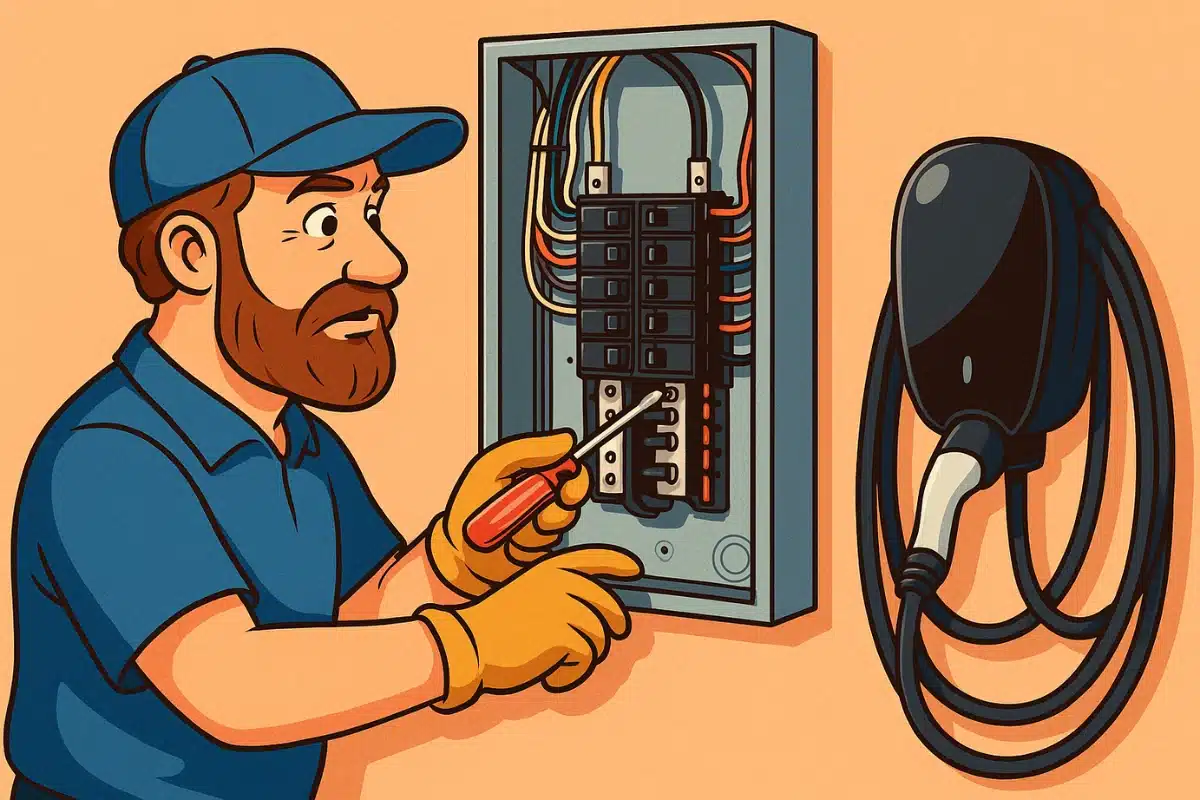
For a typical detached home, the Electrician runs a dedicated cable in conduit from your panel to the charger location in the garage or carport.
For townhouses and strata units, things can be more complicated. Sometimes the panel is in the basement or in a locked electrical room. In those cases, your Electrician works with the strata to plan a safe route for wiring and might recommend a metered solution so only your unit pays for your charging.
In all scenarios, permits and inspections matter. In BC, licensed contractors pull the permit, complete the work, and arrange for inspection, so you are not stuck dealing with paperwork.
The Installation Process: What Actually Happens
If you have never had electrical work done at this scale, you might wonder what the process feels like in real life.
A typical EV Charger installation in a Burnaby home follows these steps:
1. Site Visit And Assessment
A licensed electrician visits your home, inspects your panel and parking area, and assesses how you use your vehicle. They discuss your charger choice, cable length, mounting location, and whether any trenching or wall drilling is needed.
2. Quote And Permit
You receive a detailed quote that outlines labour, materials, and any potential extras. Once you approve, the Electrician pulls the proper permit.
3. Installation Day
On installation day, the power might be off for part of the work. The Electrician:
- Installs a new breaker in the panel
- Runs and secures the wiring
- Mounts the charger on the wall or post
- Label the circuit and test everything.
An experienced team usually completes most standard jobs in a few hours.
4. Testing And Walk-Through
Before they leave, the Electrician plugs your vehicle in, verifies charging, and walks you through the charger features. You learn about indicators, app setup if it is a smart charger, and basic troubleshooting.
5. Inspection
The local inspector may visit or review documentation to sign off that the installation meets current code and safety requirements.
From your side as the homeowner, the whole process is surprisingly smooth when you work with a professional who regularly installs EV chargers in Burnaby.
Innovative Features In Modern Home EV Charging Systems
Modern Home EV Charging Systems are more than just on and off. Many popular chargers now include innovative features that make life easier and, in some cases, cheaper.
Scheduling And Load Management
You can set your charger to run during specific hours, which is ideal if time-of-use rates or planned solar production are factors. Some chargers can even communicate with your panel to prevent system overload by automatically adjusting the charging rate.
Energy Monitoring
Most smart chargers have an app that shows:
- How much energy did you use per session
- Monthly charging totals
- Estimated Cost
This data helps you understand the real cost to operate an EV charger and lets you compare EV months to old gas bills. Many drivers find this strangely satisfying.
Integration With Home Energy Systems
If you later add solar panels or a battery system, a good smart charger can become part of a larger home energy strategy, helping you use more of your own generated power instead of sending it back to the grid.
Common Issues And Simple Troubleshooting
Even with proper installation, things can occasionally go wrong. Knowing a few basics will help you stay calm if your charger suddenly refuses to start.
Charger Will Not Start Charging
First checks:
- Is the breaker on?
- Is the connector fully seated?
- Are there error lights on the unit or the car’s dashboard?
Sometimes it is as simple as a loose connection or an accidentally pressed stop button in the app. If everything looks normal and it still will not charge, contacting a professional EV charger expert in Vancouver is safer than guessing.
Breaker Keeps Tripping
Frequent trips usually indicate either an overloaded circuit or a fault. Repeatedly resetting without understanding the cause is not safe. A licensed electrician should inspect this situation as soon as possible.
Cable Or Plug Feels Hot
Warm is normal. Hot enough that you cannot comfortably hold it is not. In that case, unplug and call an electrician. Heat is a warning sign you should never ignore.
Safety Tips For Home EV Charging Systems
EV charging technology is designed with safety at the core, but good habits still matter.
- Use dedicated circuits only. Never use power bars, extension cords, or daisy-chained adapters.
- Keep outdoor equipment weather-protected. Chargers rated for outdoor use are built to handle rain, but good placement still matters.
- Maintain clear space. Avoid storing flammable materials right beside the charger or panel.
- Teach all drivers in the household. Make sure everyone who plugs in the car knows how to start, stop, and recognize problems.
Having a professional handle installation dramatically reduces risk. Trying to DIY high-amp circuits around water, snow, and heavy vehicles is asking for trouble.
Why Working With A Local Electrician Matters
Searching online for an licensed electrician near you will give you a long list of names. However, EV charging is not just another outlet. It combines knowledge of electrical codes, load calculations, and experience with specific charger brands and EV models.
A licensed electrician in Burnaby who regularly installs EV chargers in Burnaby homes understands:
- Common local panel types found in older Burnaby houses.
- City and provincial permit requirements
- Typical parking arrangements in neighbourhoods like Metrotown, Burnaby Heights, and Big Bend
- How weather and outdoor exposure affect charger placement
That local experience saves time and reduces surprises.
If you live outside Burnaby, working with a team that services a broader area is ideal. A company that installs EV chargers in North Vancouver, Vancouver, West Vancouver, and Burnaby will have a wide range of real-world experience across different homes and site conditions.
Future-Proofing Your Home EV Charging Systems
EV adoption is accelerating. What feels “advanced” today will be normal in a few years. It is smart to think ahead when you invest in Home EV Charging Systems.
Consider:
- Extra conduit or wiring capacity for a future second charger.
- Chargers that support load sharing, letting two vehicles charge from a single circuit intelligently.
- Placement that allows different parking orientations if you change vehicles later.
- Smart chargers that can receive firmware updates as standards evolve.
Spending a little extra time now planning with a qualified electrician can prevent needing to tear things out and start again when you add a second EV or change your parking layout.
Bringing It All Together
At first glance, Home EV Charging Systems can seem complex. There are levels, amps, rates, and a lot of technical language. Once you break it down, the core idea is actually straightforward:
- Choose the right charger level for your driving.
- Make sure your electrical panel and wiring can handle it safely.
- Have a licensed electrician install and test everything.
- Take advantage of innovative features to charge efficiently and conveniently.
When all of those pieces are set up correctly, living with an EV in Burnaby becomes easier than living with a gas vehicle. You stop thinking about gas stations, winter fuel prices, or planning routes around public chargers. You plug in, sleep, and drive.
Ready To Install Your Home EV Charging System?
If you are in Burnaby or nearby and you are serious about Home EV Charging Systems, the safest and easiest next step is to talk to a qualified local electrician who does this work every day.
Care Electrical helps homeowners with EV charging projects across Burnaby, Vancouver, North Vancouver, and West Vancouver. From choosing the correct charger and explaining EV charging levels to handling permits and ensuring everything is up to code, you get a complete, worry-free service.
Visit careelectrical.ca to learn more about EV charger installation options, or use the contact page to book an on-site assessment. To see reviews, directions, and service areas, open Care Electrical on Google Maps and check how close expert help actually is to your driveway.
If you are ready to stop worrying about public chargers and start enjoying the convenience of charging at home, schedule your EV charger consultation with Care Electrical today and turn your driveway into your own private, always-open charging station.