A Complete Guide for Vancouver & West Vancouver Homeowners
As electric vehicles become increasingly popular across West Vancouver, North Vancouver, Burnaby, and Vancouver, one of the most common questions homeowners ask is:
“Can my existing electrical panel handle an EV charger, or do I need a panel upgrade?”
The answer depends on your home’s electrical capacity, existing loads, and the type of EV charger you plan to install. In this guide, we’ll explain when a panel upgrade may be necessary and how a professional electrical assessment can help determine the best solution.
Why EV Chargers Require Special Consideration
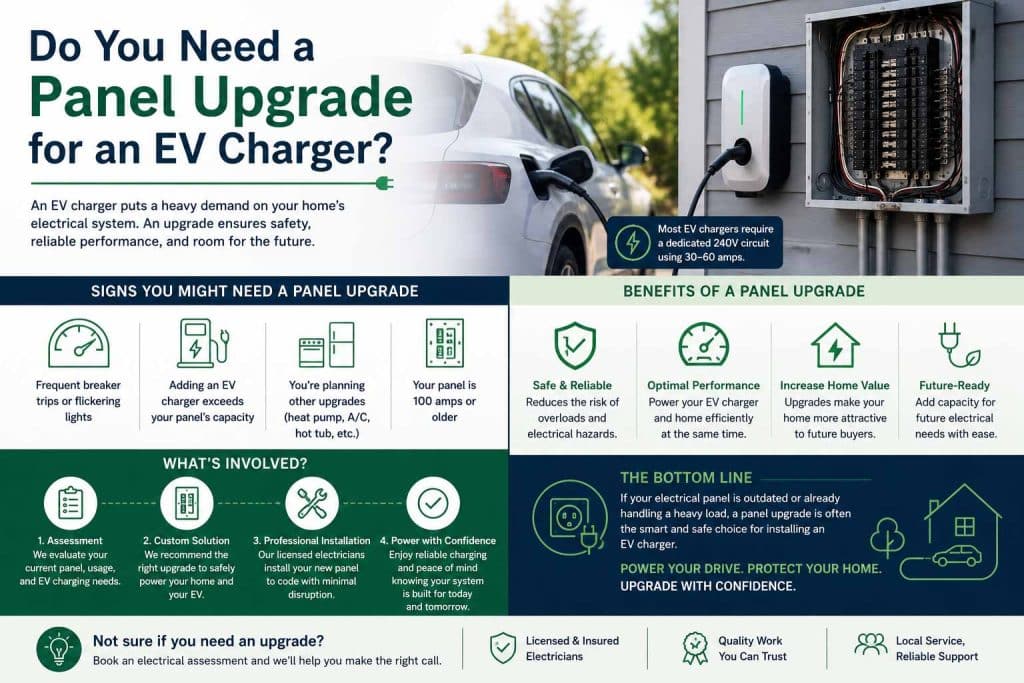
Level 2 EV chargers operate on a 240-volt circuit and are considered a continuous electrical load because they often run for several hours at a time. This means your electrical system must have sufficient capacity to safely support the charger.
| Charger Output | Charging Power | Required Breaker Size |
|---|---|---|
| 16 Amps | 3.8 kW | 20 Amp |
| 32 Amps | 7.7 kW | 40 Amp |
| 40 Amps | 9.6 kW | 50 Amp |
| 48 Amps | 11.5 kW | 60 Amp |
According to electrical code requirements, continuous loads must be calculated at 125% of their rated capacity. For example, a 40-amp charger requires a dedicated 50-amp circuit.
Do All Homes Need a Panel Upgrade?
No. Many newer homes with 200-amp electrical service can accommodate an EV charger without major upgrades.
However, older homes with 60-amp or 100-amp service may already be operating near capacity due to:
- Electric ranges
- Dryers
- Heat pumps
- Hot tubs
- Air conditioning systems
- Electric water heaters
In these situations, adding a Level 2 EV charger may require either load management equipment or a service upgrade.
Signs You May Need a Panel Upgrade
| Warning Sign | What It Means |
|---|---|
| 60A or 100A electrical service | Limited electrical capacity |
| Frequent breaker trips | Existing loads may be too high |
| No available breaker spaces | Additional circuit may not fit |
| Future home upgrades planned | Electrical demand will increase |
| Older fuse panel | Modern replacement may be necessary |
100-Amp vs. 200-Amp Service
| Service Size | Suitable for EV Charging? |
|---|---|
| 60 Amp | Usually requires upgrade |
| 100 Amp | Depends on load calculation |
| 125 Amp | Often sufficient for moderate charging |
| 200 Amp | Ideal for most modern homes |
| 400 Amp | Suitable for luxury homes and multiple EVs |
Can You Avoid a Panel Upgrade?
In some cases, yes. Modern EV Energy Management Systems (EVEMS) can monitor household electrical usage and automatically adjust charging rates when demand is high.
This technology often allows homeowners to install an EV charger without upgrading to a larger electrical service.
| Option | Best For |
|---|---|
| Standard EV Charger Installation | Homes with available electrical capacity |
| EV Energy Management System (EVEMS) | Homes near service limits |
| 200A Panel Upgrade | Future expansion and long-term value |
Example West Vancouver Project
A homeowner in West Vancouver wanted to install a Tesla Wall Connector in a home built during the 1980s.
Existing Conditions
- 100-amp electrical service
- Electric range
- Electric dryer
- Hot tub
- Air conditioning
After performing a professional load calculation, it became clear that the existing service could not safely support a 48-amp EV charger.
Recommended Solution
Because the homeowner planned to add a heat pump in the future, a complete 200-amp service upgrade was recommended rather than a temporary load management solution.
Outcome
- Tesla Wall Connector installed
- Future-ready electrical capacity
- Support for additional home electrification projects
- Improved long-term property value
Why a Professional Load Calculation Matters
Having an available breaker space does not automatically mean your panel can safely support an EV charger.
A licensed electrician should evaluate:
- Total service capacity
- Existing electrical loads
- Heating and cooling equipment
- Available panel space
- Future electrical requirements
A proper load calculation helps ensure your installation is safe, code-compliant, and designed for long-term reliability.
Need an EV Charger Installed in West Vancouver?
At Care Electrical Services, we help homeowners throughout West Vancouver, North Vancouver, Burnaby, and Vancouver determine whether their existing electrical system can safely support EV charging.
Before recommending a panel upgrade, we perform a complete electrical assessment and load calculation to identify the most cost-effective solution for your home.
Contact Care Electrical Services today to schedule your EV charger consultation.
FAQ
Do I need a panel upgrade to install an EV charger?
Not always. Many homes with 200-amp electrical service can support a Level 2 EV charger without requiring a panel upgrade. However, older homes with 60-amp or 100-amp service may need a load calculation to determine whether additional capacity is available.
Can a 100-amp panel handle an EV charger?
Yes, in some cases. Whether a 100-amp panel can support an EV charger depends on your home’s existing electrical demand. A professional load calculation will determine if your current service can safely accommodate EV charging.
What size breaker is required for a Level 2 EV charger?
The breaker size depends on the charger’s output. For example:
Charger Output Required Breaker
16 Amps 20 Amp
32 Amps 40 Amp
40 Amps 50 Amp
48 Amps 60 Amp
Electrical code requires continuous loads, such as EV chargers, to be sized at 125% of their rated current.
What is an EV Energy Management System (EVEMS)?
An EV Energy Management System (EVEMS) monitors your home’s electrical usage and automatically adjusts EV charging when demand is high. This technology can often eliminate the need for a costly panel upgrade while maintaining safe operation.
Is upgrading to a 200-amp panel worth it?
For many homeowners, yes. A 200-amp electrical service provides additional capacity for future upgrades such as EV chargers, heat pumps, hot tubs, air conditioning systems, and home additions. It can also increase your home’s long-term functionality and value.
How long does EV charger installation take?
Most standard Level 2 EV charger installations can be completed within a few hours. If a panel upgrade or service upgrade is required, the project may take longer depending on permitting requirements and the scope of work.
Can I install an EV charger myself?
In most cases, EV charger installation should be performed by a licensed electrician. Professional installation ensures the charger is properly wired, code-compliant, and safe for long-term use.
How much does EV charger installation cost in Vancouver?
Costs vary depending on the charger type, distance from the electrical panel, wiring requirements, and whether a panel upgrade is needed. A site assessment is the best way to receive an accurate estimate for your specific home.
What are the benefits of installing a Level 2 EV charger at home?
A Level 2 charger provides significantly faster charging than a standard household outlet, allowing most EVs to charge overnight. It also adds convenience, improves daily usability, and can increase your property’s appeal to future buyers.
How do I know if my electrical panel has enough capacity?
The only reliable way is through a professional electrical load calculation. A licensed electrician will evaluate your existing service, appliances, heating systems, and future electrical plans to determine whether your panel can safely support an EV charger.
“`